Event Structure and Grounded Intelligence
Anchoring in Time and Location
We live anchored in time and space, but increasingly interact through digital systems grounded in neither. It is fitting that so much of the experience feels stateless.
The challenge is not simply information overload. It is that images, video, and text often reach us without the time, place, and sequence that once helped them cohere. This changes how we attend, remember, and learn in subtle but consequential ways.
We remain more connected than ever, yet some of the boundaries that organize everyday life have become less distinct. Homes become offices, weekdays and weekends blur, and our experiences converge and blend in a single surface.
We have flexibility, access, and reach. But we can do more to give our experience continuity, cohesive structure, and meaning.
We are still refining the art and technology of externalizing memory into our environment. Event structure offers one path forward.
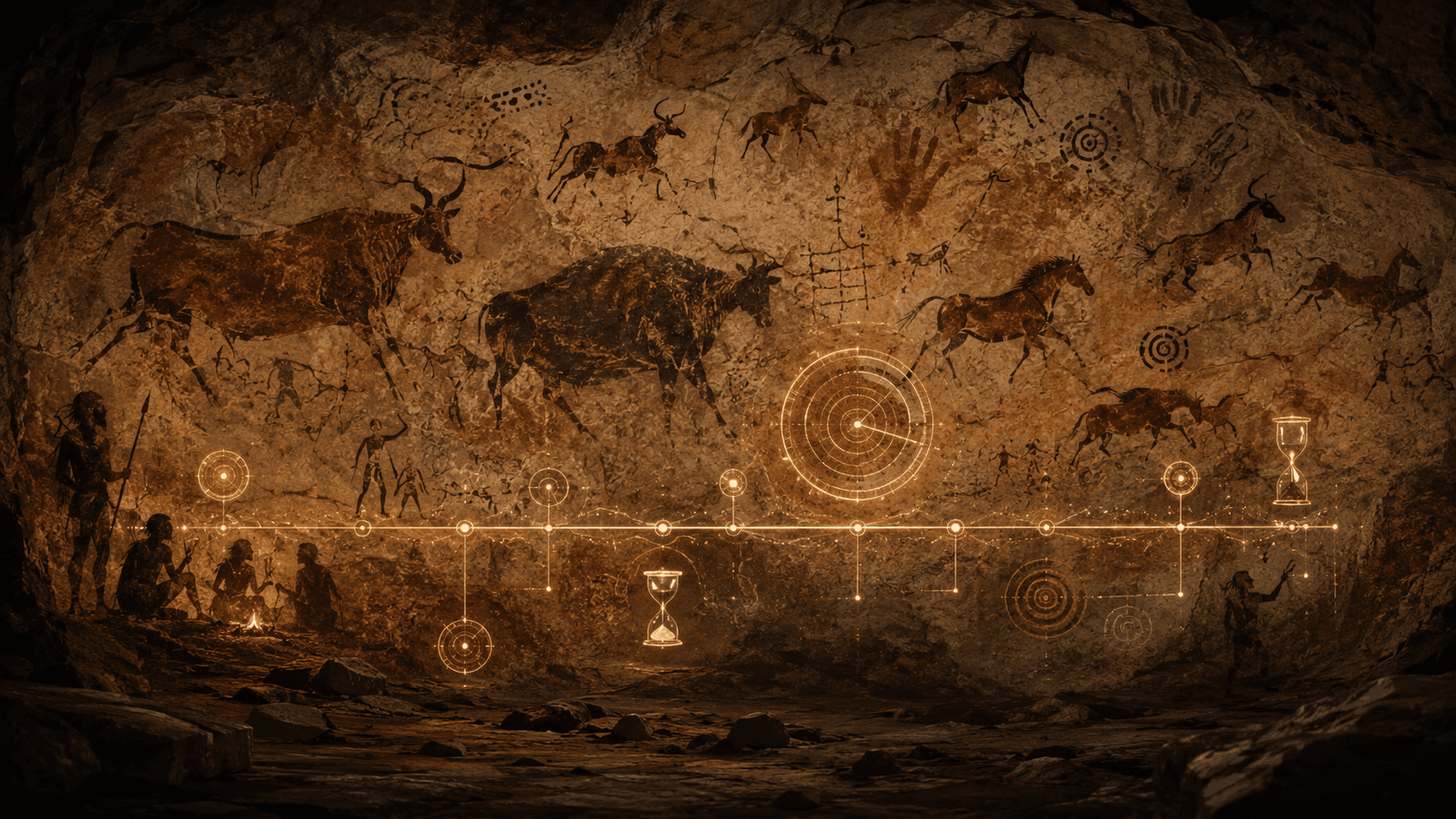
Our lasting artifacts often depicted timelines with durable event and narrative structure, preserving natural order and periodicity across seasons and generations.
Event Structure and Memory
The disorientation described is not only a problem of design and environment. It reflects a mismatch between the organization of our digital experience and the environment in which biological memory evolved.
Human memory does not preserve experience as an undifferentiated stream of sensory input. We segment continuous sensory experience into events: episodes marked by changes in scene, objective, and context. These boundaries help determine which details belong together, where one episode ends and another begins, and establish relations between our actions and their consequences in time.
Relational Position
An event is remembered not only by what it contained, but by where it sat within a larger structure: what came before, what followed, where it occurred, and how the surrounding state changed. Brains support establishing spatial, temporal, and sequential relationships, allowing memories to be organized relative to one another rather than retained as isolated traces.
This is more than metadata. Sequential position is part of the memory representation itself. Ordered neural activity can track movement through physical space, but related sequences can also represent progression through an experience. Space and time are therefore not merely labels appended after encoding; they help structure how an episode is represented and later retrieved.
Relational organization also allows individual memories to become part of broader spatial, temporal, and conceptual maps. By connecting events that occurred at different times and places, memory can support comparison, inference, and generalization.
That structure helps us compare past and present conditions and connect actions with outcomes that appear after varying delays. The value of a memory is not only in what it preserves, but in whether it can be located within the sequence of experience and used or adapted under changed conditions.
Landmark Anchoring
Memory is oriented by landmarks. In physical space, recognizable features provide stable reference points for estimating position and choosing a direction of travel.
Event boundaries serve a similar function in time. Changes in activity, setting, goals, or context mark where one episode ends and another begins. They divide continuous experience into meaningful intervals and draw attention to what changed.
These anchors support learning not by preserving every detail, but by making relevant transitions or key changes easier to detect. Without stable temporal position, spatial context, and relational structure, memory becomes an accumulation of traces rather than a navigable trajectory.
At the population level, these relationships can be understood geometrically. Neural activity may organize related locations, states, and experiences along a structured manifold, where proximity reflects similarity and trajectories reflect changing position. Landmarks provide stable reference points within that representational space, helping orient the present relative to prior states and possible directions of movement.
Artificial Grounded Intelligence
Grounding gives information temporal, spatial, and sequential position so that memory remains structured, interpretable, and useful as conditions change.
This points to a complementary north star: Artificial Grounded Intelligence.
Artificial General Intelligence aims at systems that can outperform humans across a wide distribution of cognitive and sensorimotor tasks.
Artificial Grounded Intelligence aims at systems and environments that situate information in time, place, and sequential order.
The second is not a replacement for the first. It is a complementary objective, and a critical step when bridging benchmarks to applications.
Improved grounding supports more efficient retrieval. Just as importantly, the tools we currently use to organize memory are still emerging. We have the ability to develop new interfaces for storing experience and improving planning.
There are real savings in focusing on organization: efficient retrieval is in part downstream of better structure, and event structure is a practical way to facilitate that.
Grounded Intelligence
Grounding is not only a requirement for artificial systems. It is also a design principle for the tools through which people encounter, preserve, and learn from information.
Many platforms optimize for attention, retrieval, or immediate response. They do less to help people understand what belongs together, what changed, and how one event should inform another.
Interfaces organized around events and sequence can better support reflection, continuity, and learning. Rather than prompting people with an endless succession of content, they can preserve the relationships among experiences and make those relationships easier to revisit.
Óra
Óra is an attempt to build this event substrate for human memory and intelligent planning.
It treats the timeline not as an endless stream of content and chat history, but as a sequence of durable events: structured objects around which conversations, notes, photos, links, locations, plans, and model responses can accumulate.
The timeline evolves alongside us. It preserves what happened, how events relate, and which useful information we should keep with us and share across time and with others.